Expert Explains Why Moscow and Yerevan Take Incompatible Positions on a Referendum on Armenia’s EU Membership
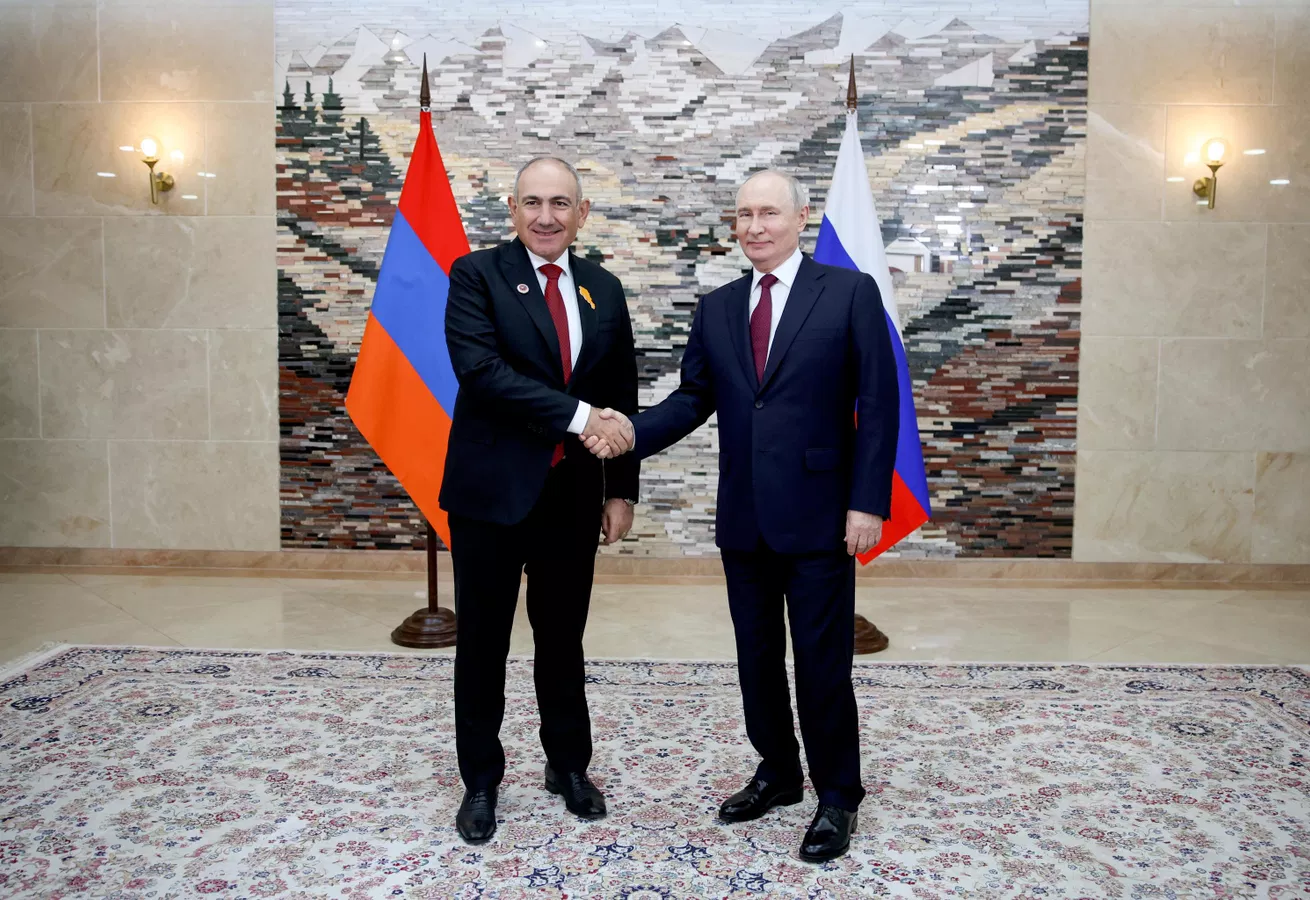
The meeting between Vladimir Putin and Nikol Pashinyan in Bishkek, as expected, failed to resolve the central contradiction in relations between Moscow and Yerevan: whether Armenia is prepared to make a final choice between Eurasian and European integration. According to Sergey Markedonov, a leading researcher at MGIMO’s Institute for International Studies, Moscow and Yerevan hold fundamentally different positions on whether Armenia should hold a referendum that could determine the country’s future foreign policy course.
Writing on the Donskoy Kazak Telegram channel, Markedonov argues that Moscow wants Yerevan to make a choice between the two integration paths as soon as possible. Armenia’s leadership, by contrast, appears in no hurry to put the question to a nationwide vote.
On 24 August, while presenting a new government programme, Pashinyan raised the possibility of holding a referendum — but only after Armenia had formally applied for membership of the European Union. A week later, however, during the meeting in Bishkek, the Armenian prime minister effectively suggested that the law “On the Beginning of the Process of the Republic of Armenia’s Accession to the European Union”, adopted in spring 2025, was intended precisely to avoid the need for a referendum. Two days later, he confirmed that Yerevan had no intention of abandoning the so-called “EU law”.
The Kremlin, judging by Putin’s remarks, would prefer a much more direct way of determining Armenia’s future course. “Ask the people what they want. They will make their choice, and we can close the matter,” the Russian president again insisted in Bishkek.
Markedonov believes that the domestic political logic of Armenia’s current government must be taken into account above all else. During Pashinyan’s years as prime minister, the idea of holding referendums has repeatedly emerged, but, as the analyst notes, none of those proposals has ultimately resulted in a nationwide vote. The most telling example, he argues, was the controversy surrounding Armenia’s Constitutional Court in 2020.
“In February 2020, Pashinyan himself actively promoted a referendum. The National Assembly scheduled it, and the president set the date for 5 April. At the time, the prime minister argued that the people should decide whether to amend Article 213 of the Constitution, which would have effectively terminated the mandates of seven of the nine serving Constitutional Court judges, including its chairman, Hrayr Tovmasyan. But the nationwide vote never took place, and the ‘revolution’ in the judicial system was carried out through parliament instead,” the political analyst said.
According to Markedonov, a referendum on choosing between the European Union and the Eurasian Economic Union could therefore prove highly risky for Armenia’s current leadership. This would not simply be a foreign policy decision but a question capable of turning into a domestic political plebiscite on public confidence in the government itself.
“A vote today for or against the EU and the EAEU would be no less risky. If the European idea loses, the government would have to resign. Armenian social media is actively discussing Iceland’s recent Eurosceptic choice. We can add two similar expressions of public will in Norway, in 1972 and 1994. Yet both Reykjavik and Oslo have far closer ties with Brussels than Yerevan does,” Markedonov said.
But, in his view, the problem is not limited to the possibility that supporters of European integration could lose.
“An equally important question is what margin of victory would be sufficiently legitimate. Fifty per cent plus one or two votes — or 85 per cent? Political and social polarisation is hardly something to celebrate. Reproducing such risks at a new stage is a dubious prospect,” the analyst warned.
At the same time, Markedonov argues that “the Armenian government understands perfectly well that an immediate break with Russia and the EAEU, here and now, would be fraught with risks — economically, politically and socially. That is why Pashinyan and his colleagues want to simply hold on for another day and another night. Perhaps Brussels will eventually invite them to the table. Then they can say goodbye to Moscow. Until then, the Armenian authorities want to refrain from making a final choice.”
According to the analyst, this is the underlying logic of Yerevan’s current policy: to preserve room for manoeuvre for as long as possible.
“Such logic would have been impeccable if Russia and the EU were still in a relationship resembling the period between 2014 and 2021. But the reality is that the confrontation between them has not stopped. As a result, today’s Armenian-style ‘diversification’ is effectively bringing that confrontation onto Armenian territory and into Armenian society,” Markedonov concluded.