Opposition leaders detained in Armenia on charges of attempting to seize power

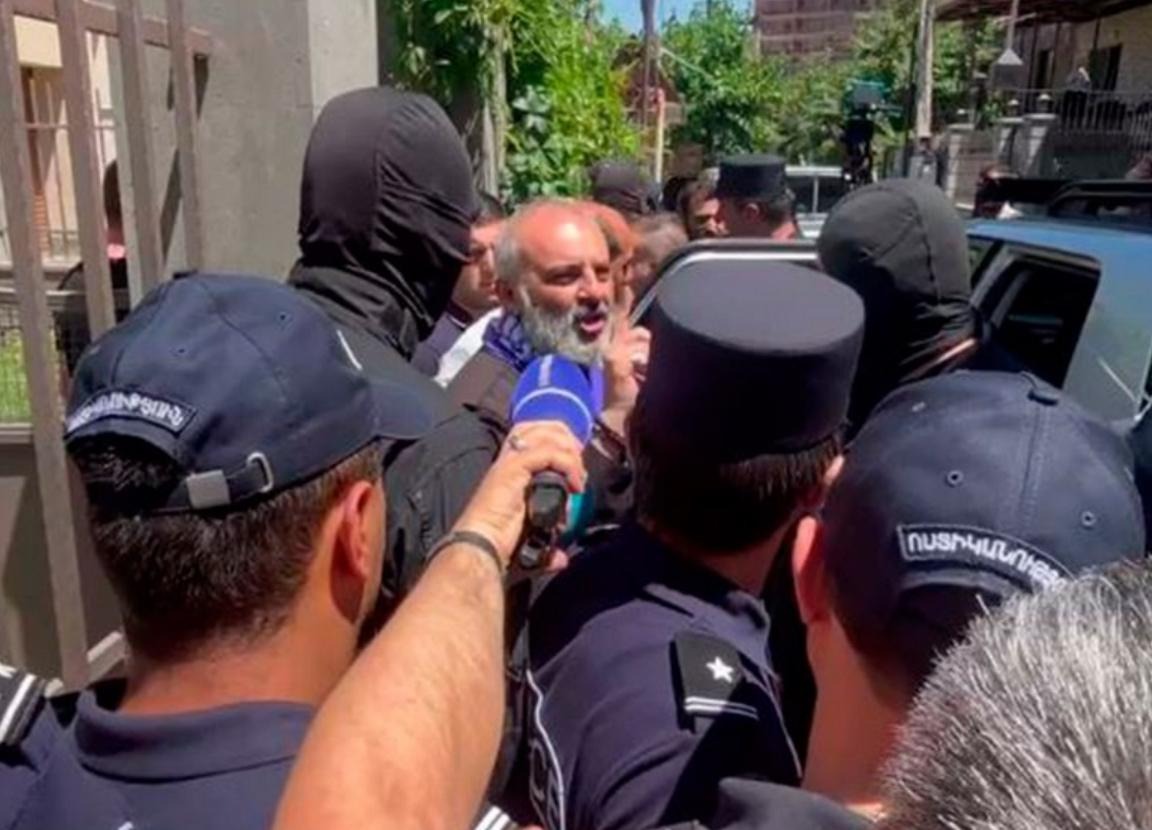
Today, after searches, the National Security Service of Armenia reported the detention of more than a dozen opposition members, including the leader of the "Sacred Struggle", Archbishop Bagrat Galstanyan - the main opponent of the government of Prime Minister Nikol Pashinyan.

In addition to him, Karabakh MP David Galstyan, retired colonel Migran Makhsudyan, member of the Supreme Body of the ARF Igor Sargsyan, businessman Tigran Galstyan, MP from the "Hayastan" faction Artur Sargsyan and others were also detained.

Nikol Pashinyan himself published a copy of the "failed" opposition plan to remove him from power on a social network. He believes that the authors of the plan are former Armenian presidents Robert Kocharyan and Serzh Sargsyan, the recently arrested businessman, Russian citizen Samvel Karapetyan and the head of the Armenian Church Garegin II

The Kremlin stated that the statement of the Armenian Prime Minister about preventing an attempted coup in the country is an internal matter for Yerevan.

"Of course, we are interested in the preservation of law and order in Armenia, so that Armenia is a prosperous, stable country, friendly to Russia," the press secretary of the Russian president Dmitry Peskov told journalists.

Earlier, the Investigative Committee of Armenia reported on the prevention of an attempted terrorist attack and seizure of power in the country, suspecting the leader of the "Sacred Struggle", Archbishop Bagrat Galstanyan.

According to the investigation, Galstanyan and a number of supporters planned to form about 200 "shock" groups from former military and police officers. They were supposed to be located in various settlements and take active actions in order to create chaos and confusion.

On June 19, a court in Yerevan arrested Russian businessman, billionaire, head of the Tashir Group of Companies Samvel Karapetyan for two months. Earlier, he publicly stood up for Catholicos Garegin II. Karapetyan was accused of publicly calling for the seizure of power in Armenia.
Последние новости
Georgia again rejected calls to join anti-Russian sanctions
Politics
Georgia again rejected calls to join anti-Russian sanctions
25 February 2026

Georgian Prime Minister Irakli Kobakhidze criticized Brussels' demands to join sanctions against Russia. He said these calls were inappropriate, given that the EU itself is a major importer of Russian products.

Ruben Vardanyan Drops Appeal Against 20-Year Sentence in Azerbaijan
Human rights
Ruben Vardanyan Drops Appeal Against 20-Year Sentence in Azerbaijan
25 February 2026

Billionaire and former Nagorno-Karabakh state minister Ruben Vardanyan, sentenced in Baku to 20 years in prison, rejected the legal force of the ruling and dropped his appeal. His family explained that this decision stemmed from the fact that, in their view, the trial was a "staged performance" rather than a proper trial: the hearings were held behind closed doors, without access to independent observers, and the prosecution's motions were ignored. The full text of the verdict was also not released.

Azerbaijani political prisoners appeal to the European Commission to address human rights in the country
Human rights
Azerbaijani political prisoners appeal to the European Commission to address human rights in the country
25 February 2026

A group of imprisoned activists and journalists from Baku's Penal Colony No. 2 has appealed to the President of the European Commission. They demand the implementation of European Parliament resolutions calling for the release of Azerbaijani political prisoners.

Chechnya Leads in Lowest Alcohol Sales
Economy
Chechnya Leads in Lowest Alcohol Sales
25 February 2026

In 2025, residents of the North Caucasus regions consumed the least amount of hard liquor in Russia. The lowest official retail sales figures were recorded in Chechnya (0.01 liters per capita). Other republics of the North Caucasus Federal District also demonstrated modest figures: Ingushetia - 0.7 liters, Dagestan - 2.2 liters, Kabardino-Balkaria - 2.6 liters, North Ossetia - 3 liters, and Karachay-Cherkessia - 3.4 liters. Experts attribute this decline to the prevalence of cultural and religious restrictions, as well as a preference for low-alcohol beverages.