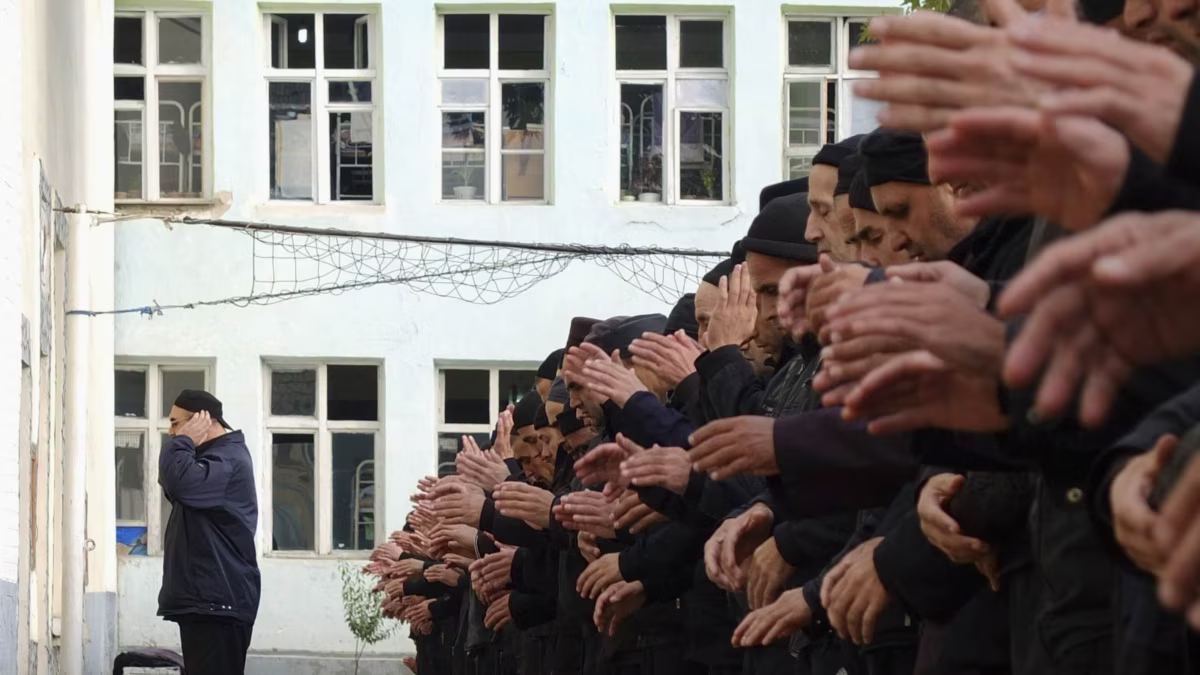
Terrorist "jamaat" found in Dagestani colony
On September 22, the Southern District Military Court in Rostov-on-Don sentenced members of the so-called "prison jamaat" from Colony No. 7 in the Dagestani village of Novo-Tyube to long terms. Makhachkala resident Rasul Magomedov received 24 years in prison as the leader of a terrorist organization, while ordinary members Biybolat Kukuyev, Abdusamad Miriev and Murad Israfilov were sentenced to terms of 18 to 19 years.
According to the verdict, members of the jamaat were engaged in propaganda of terrorism, called for attacks on law enforcement officers and for departure to Syria to join ISIS. In total, about 40 defendants are involved in the "prison jamaat" case.
Similar cases are being investigated against inmates of other colonies. Thus, Dagestani journalist Abdulmumin Gadzhiev, who is being held in the Rostov-on-Don pretrial detention center on charges of financing terrorism, wrote in his Telegram channel that prisoners from the Yashkul (Kalmykia) and Kamensk (Kabardino-Balkaria) colonies are arriving at the pretrial detention center. They are also accused of terrorism - the creation of "jamaats". The number of defendants is already in the hundreds.
According to the director of the Center for Analysis and Prevention of Conflicts, Ekaterina Sokiryanskaya, jamaats do exist in Russian prisons - these are associations of Muslims who do not want to fit into the "thieves'" hierarchy.
"Jamaats do not obey the thieves' laws, so they are forced to reckon with them," the expert says. "A person who joins a jamaat receives protection, even if he is "lowered", but he must follow certain rules and live according to Islam. They are also often joined by non-Muslims who convert to Islam in prison, often in search of protection."
Different colonies treat such communities differently. Some are loyal, some are not. The FSB sees them as a way to improve its terrorist crime detection rates.
Correctional Colony No. 7 in Novo-Tyube in Dagestan is obviously disloyal to the Jamaat. There is not even a prayer room for Muslims. This was one of the reasons for the lawsuit against the colony.
The lawsuit was filed by the Dagestani prosecutor's office. The Kumtorkalinsky District Court considered it and found the inaction of the colony's management, which does not have the necessary conditions for holding prisoners, to be illegal.
Violations in IK-7 were identified during an inspection by the Prosecutor General's Office back in November 2019 - shortly after the attempted prisoner riot. On September 20, 2019, a group of "convicts" refused to obey the demands of the FSIN employees; people quit their jobs and climbed onto the roof of one of the buildings. According to them, they were protesting against the lawlessness of the correctional facility employees and the unbearable conditions of detention. After negotiations with representatives of the FSIN and the prosecutor's office, the situation in the colony returned to normal.
A subsequent inspection showed that IK-7 did not have isolated work places, rooms for educational work, therapy, religious ceremonies, food storage and meals, and other premises necessary for a correctional facility. However, the prosecutor's order to correct these violations was never fulfilled.
Perhaps this was prevented by a change in leadership: in the same November, the head of correctional colony No. 7, Rabadan Alibulatov, and several other responsible employees of the Dagestan correctional system were detained on suspicion of corruption. And the former head of the Dagestani Federal Penitentiary Service, Muslim Dakhkhaev, who transferred to serve in Rostov, was accused of disclosing state secrets.
In March 2021, the colony in Novo-Tyube was in the news again thanks to a senior inspector who was caught committing large-scale fraud. He offered a local resident 270 thousand rubles to help with the parole of one of the prisoners. He agreed - and reported the extortion to law enforcement agencies. The inspector was detained while handing over fake money.
Apparently, all these events prevented the colony's management from correcting the violations, as required by the prosecutor's office, so the supervisory authority went to court. The Federal Penitentiary Service cites the fact that there is no money to renovate the colony.