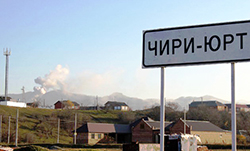
"Cleansing" of the village of Chiri-Yurt, brutal murder and ransom of the mutilated body
July 7, 2001
***
At dawn, the village of Chiri-Yurt was blocked by the Russian military, presumably from the 205th motorized rifle brigade of the RF Ministry of Defense. They arrived in armored personnel carriers: on the armor of one of them the inscription “Natasha” was read and the number 5201 was painted, on the others they were smeared with mud. In the operation that followed, a PVS inspector from the city of Shali, who arrived in a UAZ-469 car (digital part of his registration plate: 005), took part.
During the "cleansing" up to 100 men of different ages were raised from their beds and detained. They were not allowed to dress and were taken to the territory of the cement plant, where they were interrogated during that and the next day. The interrogations were accompanied by beatings, during which, as the villagers themselves later emphasized, "the father does not want to speak in front of his son, the son - in front of his father." Among those detained were the following residents of Chiri-Yurt:
1. Khasan Arbievich Astamirov, 26 years old, Lenina st., 4 (11);
2. Ismail Avtaevich Betiev, born in 1970, Lenina str., 14;
3. Islam (Ismail) Suleymanov, 16 years old, (he had a Saratov residence permit in his passport, temporarily lived with relatives);
4–5. two shepherd brothers (refused to name names).
Local residents managed to defend the teenager and two shepherds, and they were taken not to a cement plant, where the military tortured people, but to the regional center. Like most other residents of the village, they later managed to return home. For some time the whereabouts remained unknown.
All the detainees were released the next day.
During the "cleansing" some houses were robbed: the military took away video equipment, cassettes, and valuables. They killed Abu-Khamid Arsanukaev, born in 1974, in a house at 61 Lenina Street. The year before, he had returned from Russia, where he had been convicted and imprisoned for five or six years. He did not have a passport, he submitted documents for obtaining it shortly before the “cleansing”. Perhaps that is why, at the sight of the military, he rushed to run. Automatic bursts followed. The wounded man was loaded into an armored personnel carrier, and the next day his disfigured corpse was returned to his relatives.
His sister, Maret, told about how Abu-Khamid Arsanukaev was killed and what happened after that: “When the “cleansing” began, our whole family - two sisters, a brother and our mother - were at home. It was at noon. Abu Hamid sat under a canopy and did ablution before the dinner prayer. Suddenly, the soldiers burst into the yard. And immediately began to shoot in all directions. We women ducked, and my brother threw himself behind the wall of the shed. He wanted to hide, because he had not yet had time to get a passport and was afraid that because of this he would be detained. The military, and there were more than twenty of them, began to shoot after him. My brother fell, he was hit by a lot of bullets. He was mercilessly dragged to the APC and thrown there.
Then they returned and began to smash the house, saying that they were doing a search. They scattered all things, smashed everything that came to hand. They broke the windows of the Moskvich car, although we showed the documents. There were three women and four children in the yard. We were horrified. They aimed their machine guns at us and threatened to shoot us. One of them pointed a machine gun at me, and the other shoved a lemon grenade right in my sister's face. We were insulted in every way. Then they left and took our brother away.
When we calmed down a bit, we, together with the head of the village administration, Salambek Dakaev, went to the Shali commandant's office. There he was told that they would release our brother for a machine gun. But the chief of staff refused the deal, as Abu Hamid was arrested without guilt because he is not a militant. By evening, the military announced that he was not in the commandant's office.
The next morning, very early, together with the head of the administration, we again went to Shali and turned to the prosecutor's office. It was there that Salambek Dakaev found out that our brother had been dead the day before. But here, too, they demanded that we hand over the machine gun. Negotiations with employees of the prosecutor's office went on for a long time and the body was given to us only after 11 o'clock.
There were bullet wounds on the brother's body. His left ear was completely cut off and reattached with thick threads. They told me later that they cut off his ear and threw it somewhere where there were many other ears cut off from people. A human rights activist from Memorial filmed the corpse on videotape. We buried our brother on July 8, 2001 at the local cemetery. Because of the experience, our mother became ill with a heart, and now she is seriously ill. We have not applied to the prosecutor’s office yet, because we think it is useless.”
From the book "People Live Here", Usam Baisaev, Dmitry Grushkin, 2006