Zurabishvili called on the European Union to intensify the fight against Russia's hybrid war in Georgia

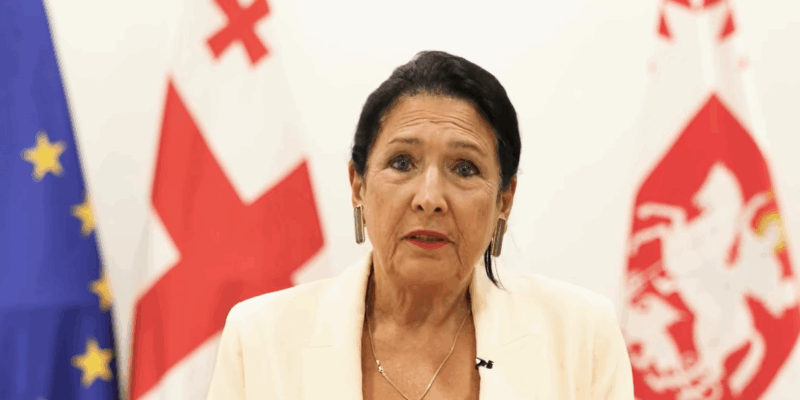
At the "Shield of Democracy" forum in Brussels, Georgia's fifth president, Salome Zurabishvili, stated that Russia's strategy against her country is based on the use of democratic instruments. She believes Moscow is using the media, social media, and elections to undermine the state from within.

"The fact is, we didn't see what was actually developing. From the very beginning, we overlooked certain signs that looked like autocratic tendencies—something that can be attributed to any government seeking to hold on to power longer than society desires. And then suddenly you see that everything completely aligns with the messages that have been spreading from Russia to various countries. And then you realize that these aren't just local autocrats trying to maintain power for money or privileges—it's part of a broader strategy," the politician shared.

Zurabishvili notes that the situation described was a stage "that the European Union either saw too late or failed to see in time." Emphasizing the EU's responsibility for the fate of the state it "returned to the greater European family," she drew a parallel with Ukraine. The former president emphasized that if "they [Russian authorities] do this where it's relatively easy, in a small country like Georgia, then countering it here is much easier than, for example, fighting it in Ukraine."

"Working against hybrid warfare requires the European Union to coordinate more, create agencies, and allocate financial resources, because this next war isn't a military one; it doesn't come with tanks. We essentially no longer have strong opposition television channels or free media platforms, and they all face serious difficulties. Of course, there's a risk that one day, similar to the Iranian model, everything could be completely shut down. However, until that happens, as long as society is alive, there's always the chance to try something new," Zurabishvili stated.
Последние новости
A case seeking to increase the fine for life-sentenced prisoner Rauf Arashukov has been submitted to the court
Society
A case seeking to increase the fine for life-sentenced prisoner Rauf Arashukov has been submitted to the court
22 February 2026

The Orenburg Regional Court has begun hearing the state prosecution's appeal in the 6-million-ruble bribe case involving former senator Rauf Arashukov. The prosecution is seeking to increase the fine for the former official, who was sentenced to life imprisonment, from 120 million to 420 million rubles.

A memorial plaque has been restored for the 20th time near Anna Politkovskaya's home
Human rights
A memorial plaque has been restored for the 20th time near Anna Politkovskaya's home
22 February 2026

In Moscow, activists have restored a memorial plaque for the 20th time on a building associated with Anna Politkovskaya. The original plaque, which had hung for nearly 20 years on the wall of the journalist's home on Lesnaya Street, was first destroyed on January 18. Since then, activists have repeatedly installed temporary plaques, which were quickly destroyed—usually within less than 24 hours.

Georgian authorities have set very low tariffs for oil transportation from Azerbaijan to Armenia
Politics
Georgian authorities have set very low tariffs for oil transportation from Azerbaijan to Armenia
22 February 2026

Georgia has decided to set a symbolic price for the transit of petroleum products from Azerbaijan to Armenia, the country's Ministry of Economy announced. This move follows a one-time free transit of oil in early December 2025, after which standard tariffs were applied.

A Dagestani teenager is facing trial for
Society
A Dagestani teenager is facing trial for "justifying terrorism."
21 February 2026

In Dagestan, a teenager is facing trial on charges of promoting terrorism. The criminal investigation against the minor has been completed. He is charged with publicly justifying terrorism (Part 2 of Article 205.2 of the Russian Criminal Code), which carries a prison sentence of up to seven years.