How the Fight for Tradition Turned Into a Campaign of Harassment Against Women in North Ossetia
In North Ossetia, a debate over the limits of acceptable public behaviour has escalated into online harassment, the publication of women's personal information, and threats of violence. Members of the group Kavkazskaya Obshchina ("Caucasian Community") describe their activities as a defence of national dignity against cultural decline and assimilation. Critics, however, argue that the group has assumed the right to judge, humiliate and punish others on behalf of an entire people.
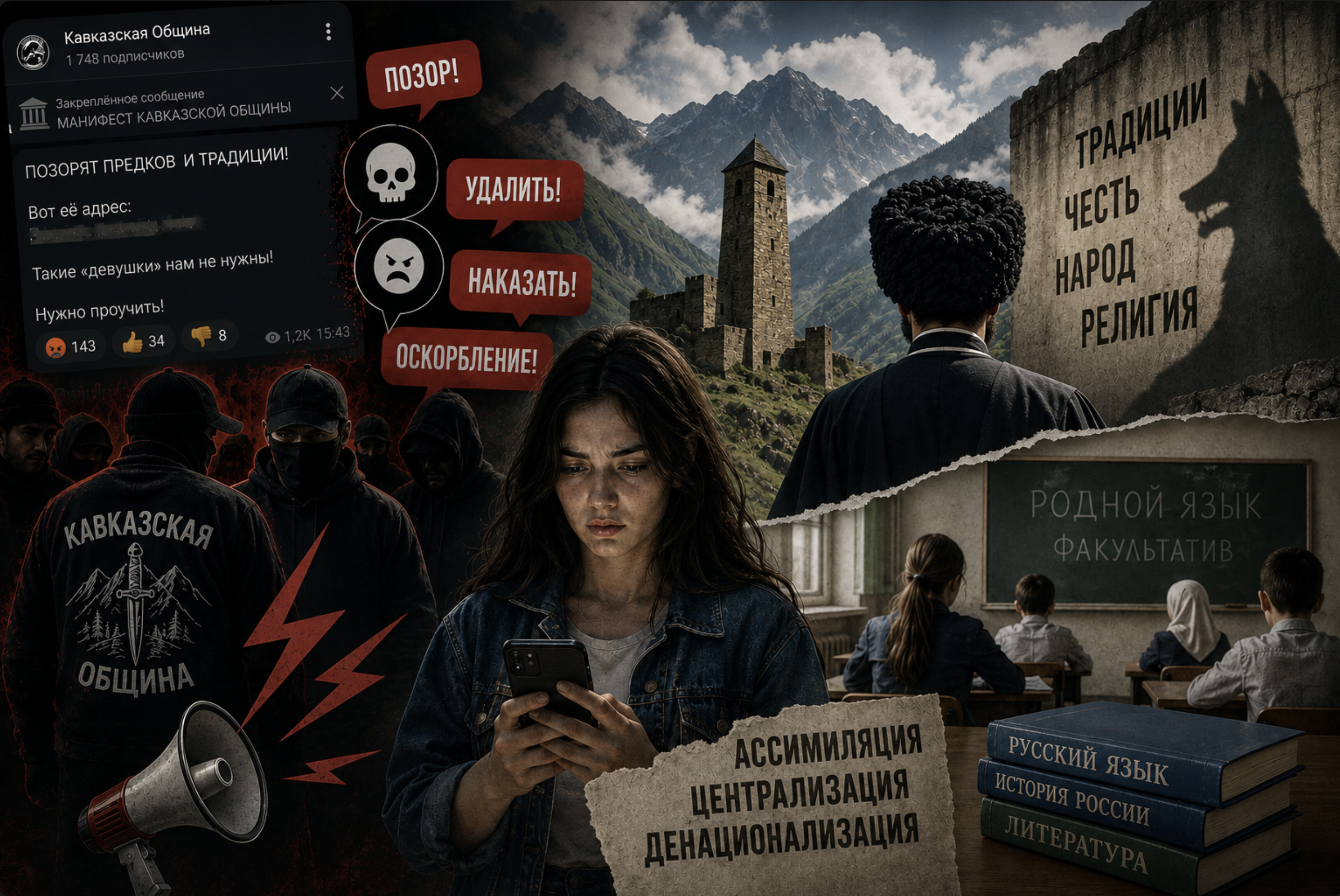
The latest wave of controversy began after members of the group drew attention to the social media account of Karina Kodzaeva, a native of North Ossetia. The trigger was a video showing her posing in jeans and a sleeveless top. Administrators of the channel described the post as an insult to the memory of ancestors and a violation of traditional norms.
Soon afterwards, Kodzaeva's personal information, including what was presented as her home address, appeared online, accompanied by threats against her and her relatives. Her social media account was flooded with abusive comments before she eventually made it private.
The case gained nationwide attention after journalist Ksenia Sobchak publicly appealed to North Ossetian head Sergei Menyaylo, urging him to comment on the situation, investigate the activities of the Caucasian Community and stop calls for violence.
"Yes, you have your own traditions, but calls to deprive women of their health or even their lives are surely not something a regional leader should ignore," Sobchak said.
She also called for the Telegram channel to be blocked for inciting hatred on the grounds of nationality and gender. At the time the controversy first emerged, neither Menyaylo nor the republic's law enforcement authorities had publicly commented.
By the time this article was prepared, the Caucasian Community Telegram channel had become unavailable. Telegram said it had been removed for violating the platform's rules and promoting violence. Individual posts, screenshots and audio recordings created by its members, however, continue to circulate online.
From "Criticism" to Threats
The Caucasian Community was established in January 2026. In its manifesto, the founders described the project as "a fortress for those who value honour above likes" and pledged to "restore respect for our home."
The group said it did not distinguish between Caucasian peoples on ethnic grounds and sought to defend justice. At the same time, its members announced plans to monitor content published by bloggers, performers and other public figures to ensure that children would not be exposed to what they described as "vulgar dances and empty jokes."
Their declared goal was to "cleanse the Caucasus of clowns and disgrace." In practice, however, the group's administrators appointed themselves arbiters of morality, deciding which clothes, professions, tattoos, dances or public statements were compatible with tradition and which allegedly disgraced an entire people.
Alongside the Telegram channel, an Instagram account titled There Is No Escort on the Caucasus appeared. It published photographs and videos of women whom the administrators accused of violating public morality.
Those targeted included women wearing revealing clothes, dancers, women with tattoos, business owners and public figures. They were labelled "escort girls" and subjected to other derogatory abuse, while followers were encouraged to take part in collective shaming.
Among those targeted were Vladikavkaz dance school director Diana Pogorelova, entrepreneur Alana Sontse and employees of a pole dance studio. Men who criticised the harassment or expressed feminist views also became targets.
According to the independent outlet Pole Zreniya, the pattern was largely the same in each case: administrators identified a woman's social media profile, provoked her into an emotional exchange through private messages and then published selected excerpts to fuel further attacks. The material was distributed through affiliated accounts before spreading to major regional social media channels.
The threats went far beyond vague promises to "shame" the women involved. Commenters called for women to be beaten, have their heads shaved, be forced to kneel or see violence inflicted on their relatives. Publishing home addresses transformed online harassment into a tangible security risk.
For critics, this marked the point at which public debate crossed into organised persecution. They argue that issues such as preserving cultural traditions, the behaviour of public figures or the influence of social media are legitimate subjects of discussion. But neither tradition, patriotism nor religious belief, they say, gives a private group the right to collect personal data, pass judgement on individuals or incite violence.
What the "Defenders of Morality" Say
The views expressed by the group's supporters extend beyond attempts to police women's behaviour. Beneath the aggressive rhetoric lies a broader fear that the North Caucasus is gradually losing its cultural identity and that national traditions are being reduced to little more than decorative folklore.
One of the movement's most prominent public supporters, artist Fred-As Betanti, argued that the group's publications should not be regarded as harassment but rather as "remarks" directed at people who serve as role models for younger generations.
According to him, elders, civic organisations and state institutions have stopped responding to behaviour that many local residents consider unacceptable. As a result, he argued, concerned citizens had stepped in to fill the vacuum.
"Someone has to speak about it," he said.
From this perspective, provocative online content is viewed not simply as a matter of personal choice but as a public humiliation of the community and another sign that assimilated North Caucasians are losing touch with their roots.
Betanti acknowledged criticism that the group focused disproportionately on women despite the region facing many other social problems. In his view, however, those other issues were already being addressed by others, whereas cultural decline remained largely ignored.
He said he would support state-imposed fines for what he described as "inappropriate behaviour" and argued that offenders should be publicly condemned. At the same time, he admitted in an interview with Pole Zreniya that the Caucasian Community had increasingly crossed ethical boundaries in pursuit of publicity.
His position helps explain the motivations of the movement's supporters, but it does not justify their methods. Concern for language and culture may be genuine. Yet attempting to preserve them through the humiliation of women transforms tradition from a living system of values into an instrument of coercion.
Why the Dispute Goes Far Beyond a Single Video
In one surviving audio recording, a supporter of the group speaks less about the woman at the centre of the controversy than about what he sees as Ossetians losing the ability to determine their own future.
He argues that decisions about "how to live, love and suffer," whom to support and how to conduct national rituals are increasingly made by outsiders. In his view, the republic is losing its political and cultural agency, while what he calls the "Ossetian religion" and traditional customs receive less protection than Christianity or Islam.
The speaker portrays Sobchak's appeal to Menyaylo as a reminder of the republic's subordinate position within Russia and as evidence that federal public figures are effectively defining the acceptable boundaries of Ossetian identity.
The recording contains offensive language directed at women and ethnic Russians, as well as rhetoric portraying society as engaged in a collective confrontation and implicitly justifying aggression. Yet reducing the speech to xenophobia alone would overlook its deeper source of frustration: the belief that local culture is gradually losing the space needed for its independent development, while its bearers are left with little more than folk costumes, dances and official celebrations.
That sense of grievance did not originate on social media. It reflects years of increasing centralisation within the Russian state and the shrinking cultural autonomy of the country's ethnic republics.
Native Language Reduced to an Elective
One of the most contentious issues remains the future of indigenous languages.
Following amendments to Russia's Law on Education, parents are now required to submit a written request if they wish their children to study a minority language. Russian itself may also be selected as a child's "native language." While the law formally preserves the right to study the languages of Russia's ethnic groups, mandatory instruction for all pupils in the republics has effectively disappeared.
Federal authorities describe the reform as protecting families' freedom to choose the language of education. National activists interpret it differently. They argue that Russian benefits from a highly developed educational infrastructure, a vast media environment and its de facto status as the language required in almost every sphere of public life. Minority languages, by contrast, depend on parental initiative, the willingness of individual schools and the availability of qualified teachers.
In practice, critics say, this formal equality overwhelmingly favours Russian. Parents frequently choose additional hours in subjects relevant to university entrance examinations instead of Ossetian. School administrations may regard minority language instruction as an optional burden that can easily be reduced. Gradually, the subject is pushed to the margins of the curriculum.
Opponents of the reform warned as early as 2018 that making minority language instruction voluntary could lead to a dramatic decline in the number of Ossetian speakers. A language that children rarely hear at school, they argued, eventually ceases to function as a full means of communication and survives mainly as a cultural symbol.
The official position remains that federal legislation continues to guarantee the right to study the state languages of Russia's republics and to receive education in native languages. Authorities in North Ossetia have likewise declared their commitment to preserving and promoting Ossetian.
The problem, critics argue, lies less in the wording of the law than in the unequal distribution of resources. Russian is essential for university admission, public service, employment in major companies and access to national media. Ossetian, by contrast, is increasingly confined to the family sphere or ceremonial occasions.
When a national language weakens and cultural policy is shaped from above, a defensive reaction often follows. Some members of society begin searching for visible symbols of national resilience in areas that are easiest to police: women's clothing, family behaviour, weddings, funerals and social media.
Yet restricting what women wear or how they dance cannot restore Ossetian language classes in schools, create modern national literature or support theatre, cinema and independent cultural debate.
A Single Ideology Instead of Cultural Diversity
Russia's system of governing its ethnic republics has become increasingly centralised in recent years. Regional leaders are expected above all to demonstrate loyalty to the federal authorities, while independent national policy is often viewed with suspicion or associated with separatism.
Publicly acceptable expressions of ethnicity tend to be limited to folk festivals, national cuisine, traditional costumes, dance ensembles and celebrations of historical figures. Far more difficult are discussions of genuine political agency, language, historical memory and the republics' right to determine their own cultural priorities.
This has created a paradox. Moscow encourages the republics to integrate into a unified political and ideological system while simultaneously urging them to preserve "traditional values." As a result, tradition loses many of its institutions and much of its linguistic foundation but increasingly becomes a tool for regulating private life.
What emerges is a substitute for a genuine national movement: instead of campaigns to strengthen schools, publishing houses, cultural autonomy and minority languages, public energy is redirected towards policing tattoos, dancing and women's clothing.
Nor can state patriotism automatically be regarded as a moral alternative to such movements. A state that narrows the space for regional self-government and does not always effectively protect victims of domestic or public violence creates conditions in which informal "courts of honour" can emerge.
At the same time, dismissing all concern for cultural preservation as backwardness offers no solution either. Such an approach only deepens the perception among many North Caucasians that they are expected to abandon their own value systems in favour of a standardised metropolitan model of life.
Women Responded in Kind
In the spring, an anonymous group of female activists launched a counter-campaign. They gained control of the Instagram account There Is No Escort on the Caucasus, removed the personal information of women who had been targeted and renamed the page There Is No Harassment on the Caucasus.
The account then began publishing material about domestic violence, harassment, threats and what it described as the double standards of the self-proclaimed defenders of morality.
The activists also began collecting information about the administrators of the original page and using similar methods against them. They said they had resorted to these tactics because appeals to the authorities had produced no results and many of the administrators were believed to be outside Russia.
The response received broad public support, with the account attracting tens of thousands of followers. At the same time, the activists acknowledged that some of their own publications could raise ethical concerns. They argued that their actions amounted to self-defence in a situation where the state had failed to stop threats and harassment.
The counter-campaign proved effective but did not resolve the underlying problem. De-anonymisation, hacking and publishing compromising material reproduce the same logic of collective punishment that the activists themselves oppose. Different motives do not eliminate the dangers inherent in those methods.
A Longstanding Pattern of Harassment
Campaigns targeting women for allegedly "inappropriate behaviour" have appeared repeatedly across the North Caucasus. With the rise of social media, local online communities have increasingly published photographs of women without their consent, criticised their clothing and private lives and accused them of involvement in sex work.
In North Ossetia, such conflicts have repeatedly spilled beyond the internet. Female tourists have reportedly been driven out of public places because of their clothing, people have been assaulted over tattoos or their appearance, and public figures have been pressured into recording public apologies.
One of the most widely known cases involved comedian Arina Lolayeva and Aleksandr Ni after they joked about the traditional Ossetian pie in 2021. Both were forced to apologise publicly, while Lolayeva later said her mother had left the republic because of the harassment. No information has emerged indicating that the threats were ever thoroughly investigated.
These cases suggest that the Caucasian Community did not create the problem from scratch. Rather, it organised existing sentiments, gave them a coordinated structure and amplified them through social media.
Who Has the Right to Speak on Behalf of Tradition?
The central conflict is not between "modern women" and the "traditional Caucasus." It concerns the right to define what tradition actually is and who has the authority to speak on behalf of an entire people.
The founders of the Caucasian Community have assumed the role of guardians of Ossetian and broader Caucasian morality. Yet they possess neither an electoral mandate nor recognised public authority, nor any legal right to impose punishment.
It is particularly questionable whether people who use misogynistic insults, issue threats of violence and replace discussion of language and historical memory with attempts to control women's bodies can legitimately claim to represent national culture.
At the same time, portraying all concern for tradition as mere obscurantism would also be mistaken. The North Caucasus does face genuine challenges related to cultural homogenisation. Minority languages are losing ground, historical issues are increasingly marginalised in public debate, and the republics continue to be integrated more deeply into Russia's centralised system of governance.
Resistance to denationalisation, however, need not take the form of violence against women. The preservation of a people begins not with the length of a skirt but with language, education, historical memory, literature, free cultural debate and society's ability to develop its own institutions.
Threatening women does nothing to protect the Caucasus from assimilation. On the contrary, it discredits the very idea of national dignity by turning it into a justification for fear and violence.
Aslan Bzarov contributed this analysis for New DOSH magazine.