Stalin Monument Erected in South Ossetia

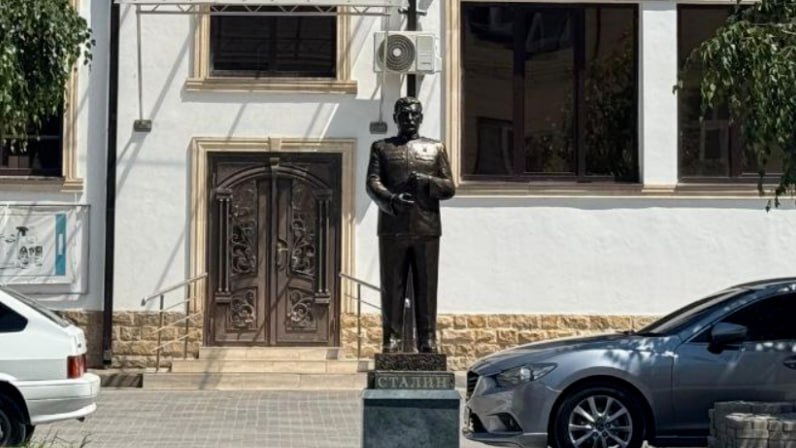
A monument to Joseph Stalin has been erected in the capital of South Ossetia, Tskhinvali. The life-size figure is located near the building of a bakery.

As the director of the bakery, Vadim Tskhovrebov, noted, Stalin's contribution to the development of the state and society "is valued higher in many countries than in ours."

In 2024, residents of the Kabardino-Balkarian Republic and Ingushetia asked the authorities not to glorify the figures responsible for Stalin's deportations. They are concerned about the increasing number of Stalin busts and monuments in his honor. There are currently more than 110 of them in the Russian Federation. There are such memorials in 40 regions, and most of them are in North Ossetia, Dagestan, and Yakutia. Recently, Russian President Vladimir Putin signed a decree assigning the Volgograd International Airport the historical name "Stalingrad."

In 1944, Soviet General Secretary Joseph Stalin ordered the deportation of Chechens and Ingush from the North Caucasus to Central Asia and Siberia. This act was recognized as genocide by many countries and the European Parliament. Half a million people were forced to leave their homes. The number of victims during the deportation exceeded a third of the total number of peoples. The Soviet government confiscated the houses, land and all property of the resettlers.

In addition to the Chechens and Ingush, Karachays, Balkars, Crimean Tatars, Koreans, Kalmyks, Germans, Ingrian Finns, Meskhetian Turks - more than a dozen ethnic groups in total - were subjected to total forced resettlement to the USSR.

On November 14, 1989, the Supreme Soviet of the USSR adopted the declaration “On the recognition of repressive acts against peoples subjected to forced displacement as illegal and criminal, and on ensuring their rights,” and on April 24, 1991, the Supreme Soviet of the RSFSR adopted the law “On the rehabilitation of repressed peoples.”

Последние новости
82 years ago, the Chechens and Ingush were forcibly deported
News
82 years ago, the Chechens and Ingush were forcibly deported
23 February 2026

February 23, 1944, marked a dark date in the history of two peoples of the North Caucasus: on the orders of Joseph Stalin, the total deportation of the Chechens and Ingush began. Half a million people were forcibly uprooted from their homes and sent into exile in Central Asia and Siberia.

A destroyed memorial plaque to Anna Politkovskaya has been restored in Moscow
Human rights
A destroyed memorial plaque to Anna Politkovskaya has been restored in Moscow
23 February 2026

Activists in Moscow have installed a memorial plaque for the 21st time in honor of Anna Politkovskaya, who was murdered in 2006. The plaque, which reads, "Anna Politkovskaya lived in this house and was vilely murdered on October 7, 2006," has previously been destroyed by unknown assailants. Activists intend to continue restoring it until it remains in place forever.

A case seeking to increase the fine for life-sentenced prisoner Rauf Arashukov has been submitted to the court
Society
A case seeking to increase the fine for life-sentenced prisoner Rauf Arashukov has been submitted to the court
22 February 2026

The Orenburg Regional Court has begun hearing the state prosecution's appeal in the 6-million-ruble bribe case involving former senator Rauf Arashukov. The prosecution is seeking to increase the fine for the former official, who was sentenced to life imprisonment, from 120 million to 420 million rubles.

A memorial plaque has been restored for the 20th time near Anna Politkovskaya's home
Human rights
A memorial plaque has been restored for the 20th time near Anna Politkovskaya's home
22 February 2026

In Moscow, activists have restored a memorial plaque for the 20th time on a building associated with Anna Politkovskaya. The original plaque, which had hung for nearly 20 years on the wall of the journalist's home on Lesnaya Street, was first destroyed on January 18. Since then, activists have repeatedly installed temporary plaques, which were quickly destroyed—usually within less than 24 hours.