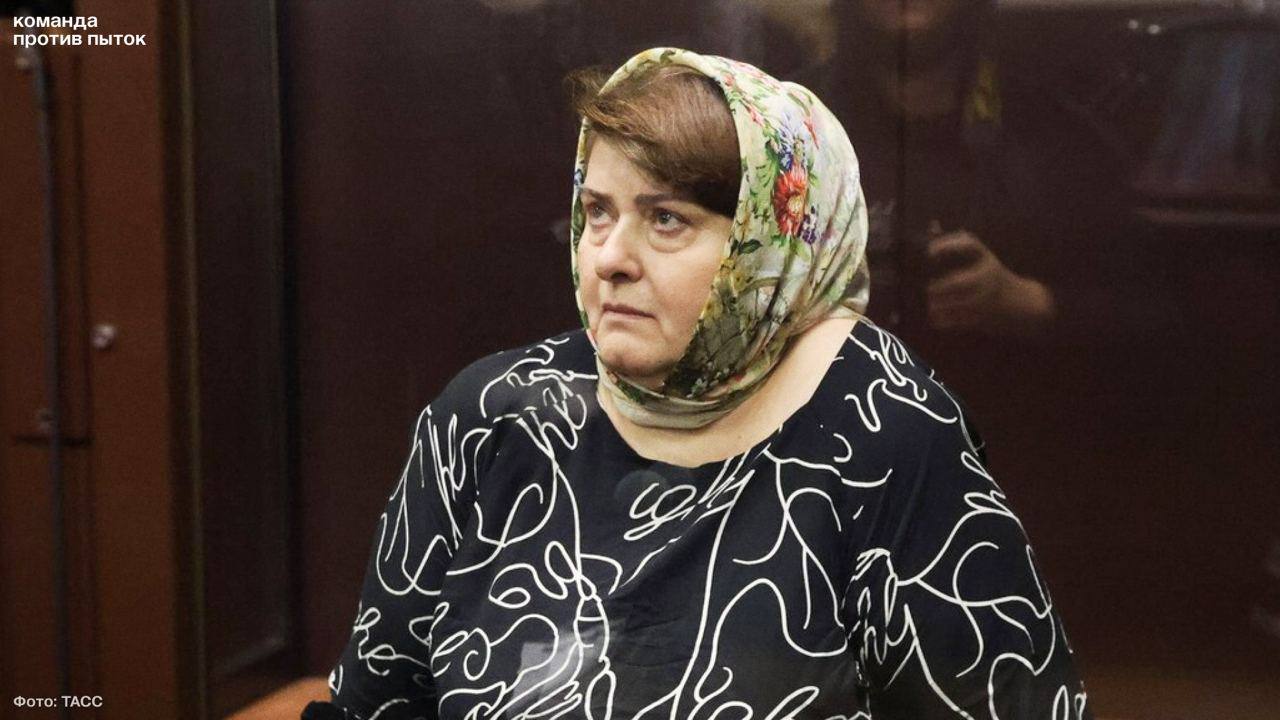
Zarema Musayeva will remain in pretrial detention until at least May 1

The Supreme Court of Chechnya refused to release Zarema Musayeva from custody. The lawyer of the "Team Against Torture" asked the court to soften the measure of restraint.

"If Musayeva's measure of restraint is changed to house arrest or a ban on certain actions, she will be able to leave the Grozny pretrial detention center and seek the necessary help and rehabilitation from doctors," the lawyer noted.

The prosecutor considered that the court did not justify the need for further detention and asked to send the materials for a new trial.

Recall that at the same time, the Shali City Court began the debate of the parties in the criminal case on disorganization of the activities of the colony (Part 2 of Article 321 of the Criminal Code) against Zarema Musayeva. According to investigators, the seriously ill woman attacked the escort accompanying her to the hospital, scratched his neck and tore off his shoulder strap.

Zarema Musayeva denies the charges against her. Earlier in court, she quoted the words of the alleged victim Bekbulatov: "Your children write all sorts of things, including about me. I will say that you attacked me."

Zarema Musayeva is the wife of former federal judge Saidi Yangulbaev and the mother of Chechen activists Ibragim, Baysangur and Abubakar Yangulbaev. In early March 2024, the Pyatigorsk Cassation Court reduced her sentence on the previous charge, reducing her prison term from 5 years to 4 years and 9 months. In July 2023, a court in Grozny found the woman guilty of using violence against a police officer and fraud and sentenced her to five years in prison. Investigators believe she scratched the face of a Chechen police officer during her transfer from Nizhny Novgorod to Grozny. Human rights activists claim the woman was kidnapped as a hostage and convicted for her sons' opposition activities.
Последние новости
Opposition protest, resignation, and Pashinyan’s return: Armenia’s new parliament begins work
Politics
Opposition protest, resignation, and Pashinyan’s return: Armenia’s new parliament begins work
2 August 2026

The inaugural session of the ninth convocation of Armenia’s National Assembly took place in Yerevan. The new parliament began its work with a political protest: during the swearing-in ceremony, opposition representatives refused to stand or recite the oath, whereas deputies from the ruling party stood while doing so. That same day, Nikol Pashinyan’s government resigned, in accordance with the Constitution.

North Ossetian Police Launch Inquiry Into Threats Against Women Linked to Telegram Channel
Society
North Ossetian Police Launch Inquiry Into Threats Against Women Linked to Telegram Channel
1 August 2026

Police in Russia's North Ossetia have launched an inquiry following a campaign of online harassment targeting women through the Telegram channel Kavkazskaya Obshchina ("Caucasian Community"). The channel's administrators published women's personal information, insulted them and issued threats of violence over behaviour they claimed violated Caucasian traditions. 

Human Rights Advocates Question Investigators' Claims Linking Batalkhadzhins to the Caucasus Emirate
News
Human Rights Advocates Question Investigators' Claims Linking Batalkhadzhins to the Caucasus Emirate
1 August 2026

Russian law enforcement agencies have claimed that members of the Batalkhadzhin Sufi community were linked to the Caucasus Emirate*, a militant Islamist organisation. Human rights advocates, however, have questioned the allegations, noting that the group effectively ceased to exist more than a decade ago and that publicly available case materials contain little evidence of specific acts of support for militants.

Threat of Muslim Alkhazov's Deportation From Germany Raises Fresh Concerns Over the Status of Chechen Asylum Seekers in Europe
Human rights
Threat of Muslim Alkhazov's Deportation From Germany Raises Fresh Concerns Over the Status of Chechen Asylum Seekers in Europe
1 August 2026

Germany's decision to deport Chechen-born Muslim Alkhazov despite claims by his legal team that his family has been persecuted has sparked renewed concern among Chechen human rights advocates and members of the diaspora across Europe. They argue that the case could signal an emerging shift in how European authorities assess asylum claims filed by people from Chechnya.